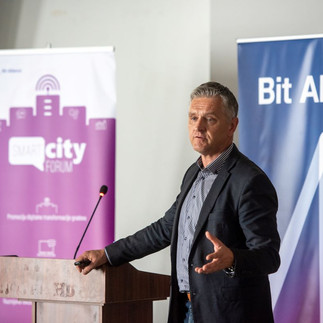
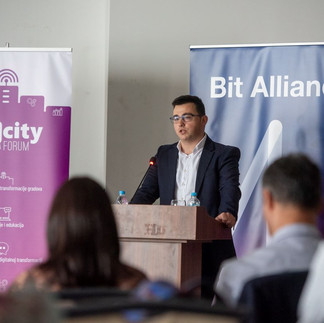
The Fifth Smart City Forum brought together domestic experts and innovative ideas
- Bit Alliance
- May 31, 2023
- 4 min read

Updated: Nov 24, 2025
31.05.2023.

Improving Quality of Life in BiH Through Digital Technologies
Digital technologies are essential for the development of smart cities, but to what extent and in what ways can investment in these technologies ease and enhance the everyday lives of all citizens? This was the central question of the fifth Smart City Forum BiH, an event held on Tuesday, 30 May 2023, in Sarajevo, bringing together representatives of local governments, IT companies, educational institutions, and international cooperation organizations.
At a time when digital technologies drive quality of life across Europe and the world, only 1% of local communities in Bosnia and Herzegovina demonstrate the digital maturity needed to improve citizen services. Less than 10% of their budgets are directed towards development interventions and public service improvements, and two-thirds of citizens feel they have no opportunity to participate in decision-making in their local communities.
Findings from this USAID study show an urgent need for the development of the IT industry and the implementation of smart solutions in cities to improve planning and public service management—ultimately building trust, increasing satisfaction, and creating prosperous communities across the country. This is especially important given that most of the world’s population lives in cities today, and by 2050 an estimated 70% of people will reside in urban areas.
Five Cities with Action Plans
The Smart City Forum was opened by Damir Maglajlić, Executive Director of Bit Alliance, who emphasized that this platform serves as a space for the exchange of innovative and practical ideas, and that it grew out of a vision for cities to become hubs of sustainable development. He highlighted that collaboration among all stakeholders and continuous exchange of knowledge, ideas, practices, and lessons learned are essential prerequisites for success.
One of the key partners, the Deutsche Gesellschaft für Internationale Zusammenarbeit (GIZ), supports various digitalization processes across the public and private sectors in Bosnia and Herzegovina.
“When it comes to smart cities and the digitalization of the public sector, we have been working with Bit Alliance, LANACO, and DVC Solutions for two years on the initiative ‘Smart Cities – Towards the Digital Transformation of Cities in BiH.’ Action plans for the digital transformation of five municipalities—Prijedor, Zenica, Tešanj, Pale, and Zvornik—have been developed. I am confident that such a strategic document opens new opportunities and represents the first step in a planned process of digital transformation, which is essential if we want tangible results,” said Bojan Vojvodić from GIZ.
The project also includes the demonstration of smart solutions in these municipalities, specifically the smart parking system “GoParking” and the citizen reporting service “Građanska patrola,” which enables residents to directly participate in creating a better environment within their communities.
Ajla Mostarac and Saša Kotlica from USAID’s Local Governance Assistance Project (LGAA) offered a fresh perspective and insights into innovative solutions used internationally. They also announced a program that, over the next five years, will strengthen the capacities of 30 local communities to provide more efficient, transparent, and accountable public services, as well as help them better plan, manage, and improve service quality.
Uniting Education, Local Communities, and Industry
During the segment dedicated to presenting smart solutions by local companies, Bojan Vuković (DVC Solutions), Adnan Hantalašević (QSS), Elvis Pivić (Agilitas), Feđa Oručević (ALEM Systems), and Darko Šerval (Supernova) showcased the impressive work of domestic IT companies and highlighted the need to implement these solutions within local development processes.
The fifth Smart City Forum was moderated by Prof. Jasna Kovačević from the Faculty of Economics in Sarajevo, with special emphasis placed on the role of academia in developing and implementing the smart city concept.
Prof. Gordana Gardašević from the Faculty of Electrical Engineering in Banja Luka presented an application for tracking bus arrivals, stressing the importance of continuity in development as well as expanding the smart city concept to include a wider range of societal needs.
“Many proposed solutions address only one issue faced by civil society. We must step out of this comfort zone and tackle broader challenges beyond smart parking or bus tracking in order to support all segments of society that need help through digitalization,” Gardašević said.
Nikola Kukrić, MSc Eng., from the Faculty of Electrical Engineering in East Sarajevo, spoke about how educational institutions can contribute to smart city development. He highlighted the importance of interpreting collected data and providing guidance to citizens, as well as the “holy trinity” of educational institutions, local communities, and the IT industry.
Limited Budgets as a Key Challenge
An important part of the Smart City Forum was the panel discussion “Financial Challenges and Limitations in Local Government Operations: How to Manage Limited Resources?” featuring Admira Kličić (Head of IT Technologies Department, City of Prijedor), Faris Hafizadić (Municipality of Travnik), and Adnan Međedović (Managing Partner, Advantage Capital).
Speaking from a local government perspective, Kličić reminded participants that these solutions are designed for citizens, yet most local governments struggle to allocate even 1% of their budgets for such purposes. With such limited funds, quick progress is impossible, making innovation, daily operational savings, and clear development goals and strategies essential.
Participants also discussed how local communities can position themselves as attractive and competitive destinations for investment during challenging times, as well as topics such as bureaucracy, civic engagement, pathways to innovation, the effectiveness of the public sector, and digital transformation as an opportunity that must not be missed.
Smart City Forum, designed as a continuous meeting place for key stakeholders in smart city development, was organized by Bit Alliance—the umbrella association of IT companies in Bosnia and Herzegovina—with the support of GIZ and the companies LANACO and DVC Solutions.