Digital transformation is an increasingly topical topic in the public sector as well
- Bit Alliance
- Aug 31, 2022
- 4 min read

31.08.2022.

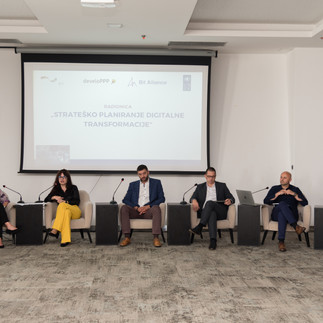
Yesterday, on August 30, 2022, a workshop entitled "Strategic planning of digital transformation" was held in the premises of the Hills Hotel, jointly organized by Bit Alliance, GIZ and UNDP. The event was attended by numerous key actors in the digital transformation of public local governments, the private sector, non-governmental organizations and institutions across BiH.
The digital transformation of cities and municipalities as well as public institutions and organizations is an unstoppable process, caused by the expansion of telecommunications development, the development of new technologies and citizens' expectations for more efficient and accessible public sector services. The process of digital transformation is complex and long-lasting, and it is necessary to implement it both strategically and visionarily.
As part of the project "Digital transformation in the public sector in BiH", UNDP has developed a methodology for assessing the digital readiness of institutions/organizations and local self-government units (LGUs), as well as the preparation of a roadmap and action plan for digital transformation. The methodology has been piloted in several LGUs and institutions, and the second cycle of planning is underway in 5 cities and municipalities, which is being implemented as part of the project "Smart cities - towards the digital transformation of cities in BiH" implemented by GIZ, the companies Lanaco and DVC Solutions, and Bit Alijansa, the association of IT companies in BiH.
The event was opened with an introductory speech by Kristina Erak, operations manager of Bit Alliance and coordinator of the "Smart cities - towards digital transformation of cities in BiH" project.
"Digital transformation is a process that we must enter into plannedly, with a vision and clear steps of implementation, that is why, according to the methodology of the World Bank previously adapted and developed by UNDP, we are working on the creation of strategic documents - Assessment of the digital readiness of local self-government units and Roadmap of digital transformation. These documents are designed as a guide in all processes, and the methodology itself is offered for use by all other LGUs and institutions that are just starting on this path" - said Kristina.
Ivana Šarić, E-government Analyst of UNDP in BiH, presented the project "Digital transformation in the public sector in BiH", while Bojan Vojvodić, project manager of GIZ in BiH presented the project "Smart cities towards the digital transformation of cities in BiH".
"Assessing the digital readiness of local self-government institutions is one step in a structured approach to the development of the digital transformation of local self-government. The assessment of digital readiness of institutions is done in three phases. The first phase includes the analysis of the current situation in the local self-government unit through 9 basic pillars (management, user-oriented design, public administration reform, organizational culture and employee skills, technological infrastructure, data infrastructure, strategy and management, Cyber security, privacy and resilience, legal basis and innovation ecosystem. The second phase includes planning the digital transformation of the local self-government unit, which as a result a road map and an action plan that accurately defines the projects of digital transformation, the priorities, the financial value of the project, and the expected deadlines for implementation so that the local communities themselves have clearly defined steps and projects that will enable them to undergo digital transformation. DGRA) of the World Bank," said Ivana Šarić in his opening address.
The aforementioned methodology is offered for use by other interested local self-government units and institutions in Bosnia and Herzegovina.
The panel discussion on the topic "Examples from the practice of digital transformation planning in BiH" contributed to the quality content, and the participants were experts from this area, as well as consultants of public local governments as part of the project: Edna Karadža (Expert for the development of smart cities), Lejla Turulja (Faculty of Economics, University of Sarajevo), Aleksandar Mastilović (Expert for the development of smart cities), Srđan Nogo (Faculty of Electrical Engineering, University of East Sarajevo), Adnan Kulovac (Ministry of Defense BiH) and Amir Husić (Ministry of Security of BiH).
As part of the panel, many current topics in this area were discussed, as well as the problems faced by local communities in the implementation of digital transformation projects (lack of professional staff, lack of financial resources, change in the awareness of employees in the administration...).
"As as a result of such events, I expect that representatives of local communities will understand the importance of digital transformation and understand how the successful implementation of this process will bring great benefits to citizens and business entities as well as to the local community itself. In order for this process to start successfully, it is necessary to determine the initial state through the Assessment of the digital readiness of the local community, precisely define the steps and implement digital transformation projects based on them. The purpose of this training is to expand knowledge and experience in terms of assessing the digital readiness of local self-government units, as well as individual institutions at various levels of government in Bosnia and Herzegovina, in such a way that they will receive additional information and clarified recommendations delivered by consultants," said Amir Husić, a consultant for the development of digital transformation.